


Label errors are a massive liability for modern manufacturers, and the financial consequences of a misprint or misalignment are staggering. In 2024, label errors accounted for 45.5% of all US food recalls, costing the food industry an estimated $1.92 billion in direct recall expenses. Operations managers and packaging engineers face immense pressure to keep high-volume production lines moving without generating scrap or triggering compliance failures. A single unreadable barcode brings the entire packaging line to a halt, destroying your throughput metrics for the shift.
With label errors costing the industry billions in recalls and rework, relying on outdated or poorly calibrated machinery is a risk manufacturers can no longer afford. To maintain high-speed throughput without sacrificing accuracy, facilities must invest in versatile CTM labeling systems that can seamlessly adapt to different application methods and product shapes.
Upgrading your hardware is only the first step. Understanding the exact mechanical differences between tamp-blow and wipe-on applicators—and calibrating them correctly—is the key to eliminating bottlenecks and maintaining strict compliance.
The Mechanics: Tamp-Blow vs. Wipe-On
The application style you choose ultimately dictates your equipment sizing, footprint, and daily line setup. Making the wrong choice for your specific product type leads directly to misaligned labels, frequent jams, and constant sensor misreads. You need to evaluate the physical dynamics of each system before installing new machinery on your line.
Engineers must look beyond basic speed ratings and understand how the label physically separates from the liner and meets the product substrate. These mechanical actions determine how much maintenance and calibration the system will require during a busy shift.
Tamp-Blow: The Contactless Approach
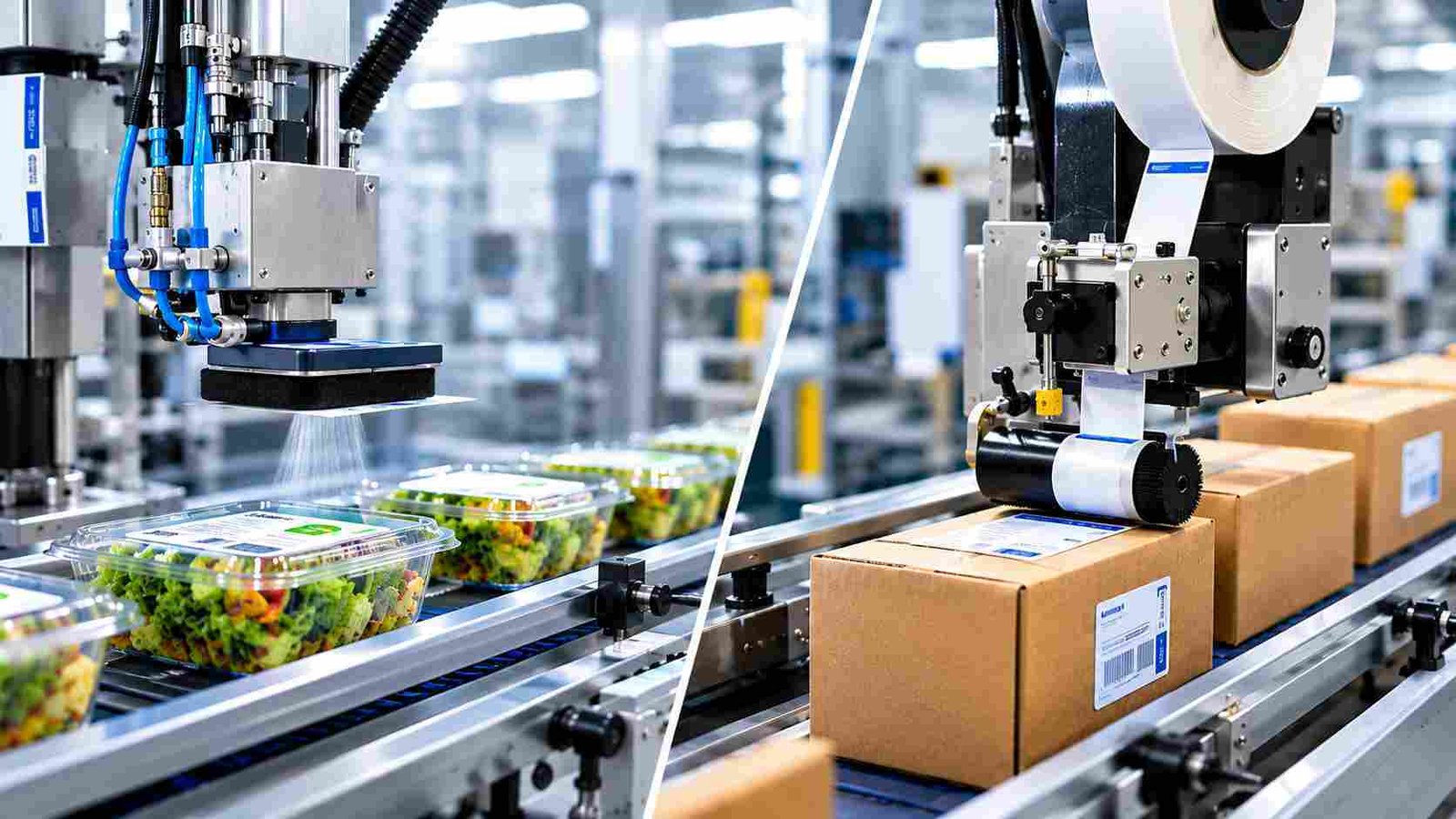
Tamp-blow applicators use a vacuum grid to hold a dispensed label in place on a tamp pad. As the product passes a sensor, a highly targeted burst of compressed air forces the label off the pad and onto the product surface.
This pneumatic blast requires meticulous harmonic and timing calibration to ensure placement accuracy. If the air pressure is too high, the label can skew mid-air; if the timing is slightly delayed, the label misses its target window entirely.
The primary advantage of this contactless nature is product protection. Because the tamp pad never physically strikes the item, tamp-blow is highly advantageous for labeling fragile items, baked goods, or products with uneven and recessed surfaces that would jam a contact applicator.
Wipe-On (Merge): High-Speed Synchronous Application
The wipe-on, or merge, process dispenses the label synchronously with the product moving down the conveyor. As the product passes the peel blade, the adhesive side of the label makes direct contact with the item, and a brush or roller immediately wipes it down to secure a strong bond.
This method relies heavily on continuous motion and strict servo-mechanical calibration rather than intermittent pneumatic bursts. The applicator drive roller must feed the label at the exact same velocity as the passing product.
While this mechanical setup is theoretically much faster and can achieve higher throughput rates, it is less forgiving of line fluctuations. Any sudden change in conveyor speed without a corresponding adjustment in the dispense rate will instantly cause the label to buckle, wrinkle, or tear.
The Right Method for Your Product and Surface
Packaging engineers frequently ask which labeling method is best suited for their specific operational challenges. The answer depends entirely on the physical characteristics of what you are packaging and how fast you need it to move. Fragile items require a gentle touch, while sturdy, flat cartons demand maximum speed and continuous motion.
Selecting the wrong technology forces maintenance teams to constantly fight the equipment. Below is a breakdown of how these two dominant methods compare across common production line criteria.
| Feature | Tamp-Blow Labeling | Wipe-On (Merge) Labeling |
|---|---|---|
| Ideal Product Types | Fragile items, electronics, baked goods, recessed clamshells. | Flat cartons, sturdy boxes, uniform bottles, high-volume shipping cases. |
| Application Speed | Moderate to Fast (intermittent motion). | Ultra-Fast (continuous motion). |
| Surface Compatibility | Excellent for uneven, textured, or recessed surfaces. | Best for flat, smooth, and highly uniform surfaces. |
| Contact Type | Contactless (relies on air pressure). | Direct Contact (relies on brushes or rollers). |
Variables like product shape, substrate material, and overarching packaging dynamics should ultimately drive your equipment sizing and selection. A line primarily handling heavy shipping pallets requires different mechanics than a primary packaging line running delicate pharmaceutical vials.
Calibration and Synchronization for High-Speed Lines
Even the best CTM systems require precise tuning to match the physical realities of your specific packaging line. An out-of-the-box machine will not perform at peak efficiency until a maintenance supervisor dials in the settings to account for environmental factors, conveyor wear, and product weight.
Failing to calibrate these systems leads to the most common errors on the plant floor: label misalignment, poor adhesion, and extended line downtime. You can prevent these recurring headaches by mastering a few core engineering concepts specific to your chosen applicator.
Synchronizing Conveyor Speeds for Wipe-On Applicators
Properly synchronizing a wipe-on labeler with your conveyor speeds is a delicate balancing act. The applicator dispense rate must match the conveyor speed perfectly. If the conveyor pulls the product faster than the label dispenses, the label will stretch and tear before it clears the peel blade.
Conversely, if the label dispenses faster than the product moves, the excess material will buckle and wrinkle against the carton. This ruins the presentation and often renders the barcode unreadable by downstream scanners.
To maintain this equilibrium at high throughput speeds, modern systems rely on intuitive label sensors and closed-loop stepper motors. These components use encoder feedback from the conveyor to detect minute speed fluctuations and instantly adjust the applicator’s drive motor, ensuring perfect synchronization without manual intervention.
Timing the Pneumatic Blast for Tamp-Blow Systems
Calibrating a contactless tamp-blow application revolves entirely around timing the pneumatic blast relative to the product’s position on the line. The photoelectric product sensor must accurately detect the leading edge of the item and trigger the air burst at the exact millisecond the target zone aligns with the tamp pad.
Sensor miscalibration or pneumatic valve delays are the primary culprits behind skewed labels or complete misses on uneven surfaces. If the air pressure builds too slowly, the product drifts past the target zone before the label releases.
Modern applicator electronics significantly simplify these timing adjustments during quick changeovers. Plant maintenance supervisors can program specific delay parameters into the PLC for different product sizes, allowing the machine to automatically adjust the pneumatic timing sequence at the push of a button.
How Equipment Choice Impacts OEE and Compliance
High-speed labeling accuracy directly influences your Overall Equipment Effectiveness (OEE) by reducing the amount of time and materials lost to rework and scrap. Every time a label folds over a barcode or prints an illegible compliance date, that product must be pulled from the line, inspected, and manually reprocessed.
These micro-stops compound quickly over a fiscal year. Relying on human operators to manually apply or verify labels is not a viable workaround for mechanical issues. Automated precision is an absolute necessity to prevent the unreadable barcodes or outdated compliance dates that trigger massive regulatory recalls. When your equipment is perfectly calibrated for your product type, you secure both your daily throughput quotas and your company’s market reputation.
The Role of System Modularity and ERP Integration
Investing in modular labeling equipment is the ultimate future-proofing strategy for packaging lines. Consumer demands and packaging designs change rapidly, and your application hardware must keep pace. You should prioritize machinery that allows for on-site software revisions, requires minimal change parts, and offers field-reversible configurations to adapt to new line layouts.
Advanced solutions like CTM 3600a-PA Print-and-Apply Systems take this a step further by integrating variable-data thermal transfer engines directly with your facility’s ERP and WMS networks. This connectivity allows the applicator to pull real-time product data—like lot codes, serial numbers, and expiration dates—directly from your central database.
This seamless data integration ensures end-to-end data integrity and real-time traceability across the supply chain. It also completely eliminates the waste and storage costs associated with managing massive inventories of pre-printed labels.
Conclusion
The choice between tamp-blow and wipe-on application methods—and the meticulous calibration of that equipment—is what separates a highly efficient packaging line from a costly bottleneck. Selecting the correct mechanical approach based on your product’s surface and line speed prevents wrinkling, tearing, and sensor misreads.
Automated, well-calibrated CTM systems solve the dual challenges of achieving high-speed throughput while maintaining stringent regulatory compliance. By matching conveyor speeds to dispense rates and integrating directly with ERP software, you eliminate the root causes of label misalignment.
Take a hard look at your current production line metrics. If micro-stops, scrap rates, and rework are dragging down your OEE, it is time to evaluate whether a modular, highly calibrated labeling upgrade is the exact solution you need to protect your bottom line.