


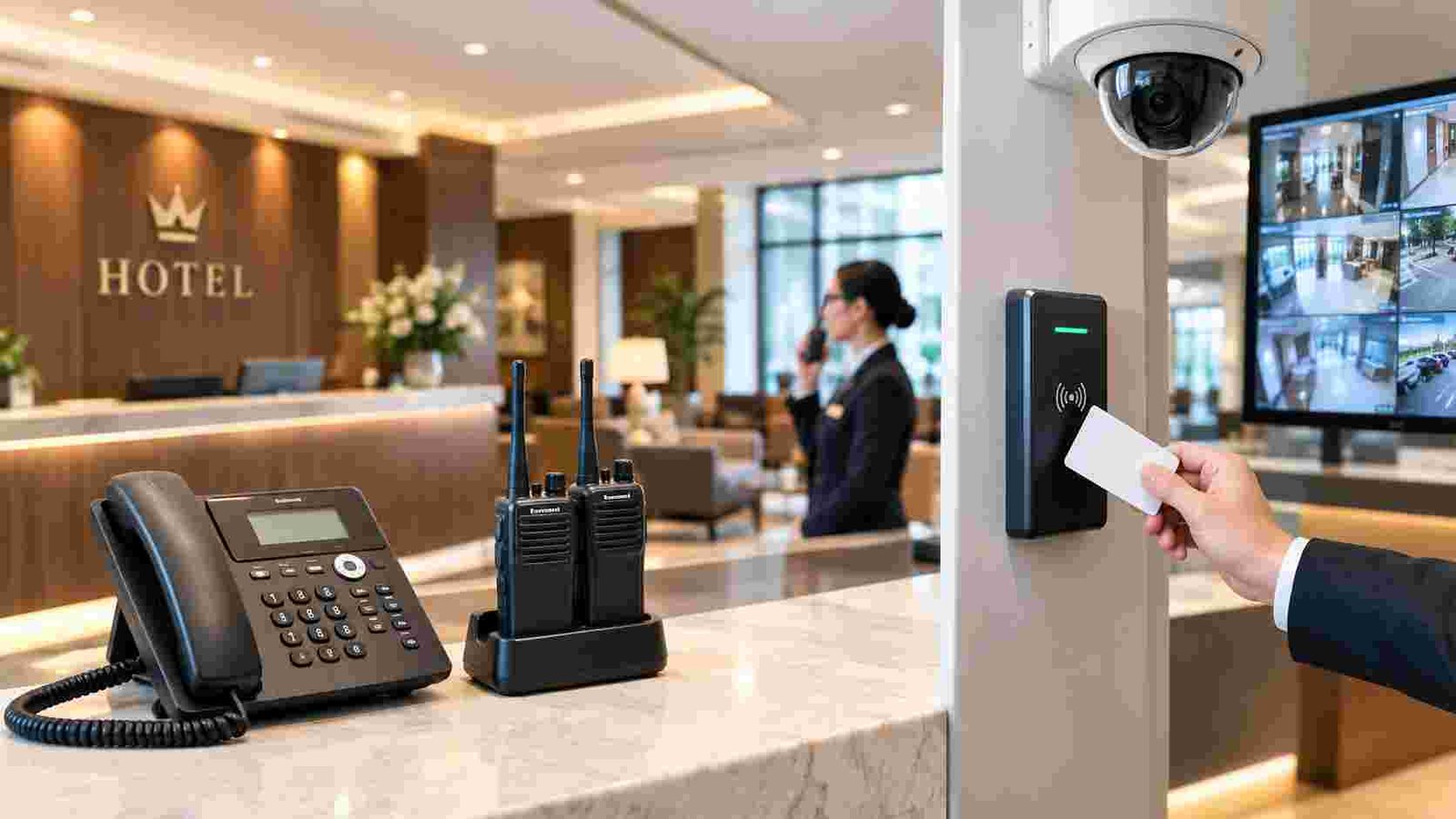
Hotels have an unusual security environment. Guests arrive and leave throughout the day, employees work across multiple shifts, and staff members may be distributed across guest rooms, kitchens, parking areas, reception desks, service corridors, and maintenance spaces. Because operations continue around the clock, communication problems can quickly become security problems.
A modern hotel therefore needs more than a lock on every guest-room door. Effective protection can involve electronic room access, CCTV, staff panic buttons, two-way radios, and modern phone systems. Each technology has a different purpose, but they become more useful when employees understand how they fit together.
The objective is not to create an unnecessarily complicated technology stack. It is to give guests and staff reliable ways to control access, identify incidents, communicate quickly, and coordinate an appropriate response.
Guest-Room Access Control Sets the Foundation
Guest-room access is one of the first areas hotels should review when evaluating security. A traditional key can open a door, but it provides limited visibility into when that key was used and whether it remains in the correct person’s possession.
Electronic access systems can provide a more flexible approach. Guest credentials can be issued for the duration of a stay, while employees can receive permissions based on their responsibilities. Housekeeping, maintenance, management, and security staff may not need identical access.
The system should also support clear procedures for lost credentials. Front-desk personnel need to know how to disable a lost card or credential and issue a replacement without creating confusion.
Access control should not be viewed separately from emergency planning. Staff need procedures for situations involving lock failures, suspicious activity, unauthorized entry attempts, or guests who cannot access their rooms.
CCTV Provides Context During Security Incidents
Cameras help hotels understand activity in areas where employees cannot maintain continuous physical observation. Entrances, reception areas, parking facilities, corridors, elevators, service entrances, and other sensitive locations may require surveillance based on the property’s layout and risk profile.
Camera selection is only part of the job. Positioning, lighting, image quality, storage, retention, access permissions, and maintenance all affect how useful recorded footage will be.
A well-designed CCTV system can also complement other security systems. If a door-access event occurs at an unusual time, relevant footage may help establish what happened. Similarly, a reported incident in a parking area can be reviewed alongside other available records.
Hotels should establish clear policies for who can view recordings and how footage is handled. Security technology becomes more useful when employees know exactly what information can be accessed and under what circumstances.
Staff Panic Buttons Need a Clear Response Process
Employees sometimes work alone or in areas away from the front desk. A panic button or personal emergency device can give them a direct method for requesting assistance when a situation becomes unsafe.
The device itself is only one part of the system. Hotels need to determine where an alert goes, who receives it, how quickly staff should respond, and what information is available to responders.
Staff training should cover realistic scenarios rather than only showing employees where a button is located. Employees should know the difference between routine assistance and an emergency alert and understand what happens after an alert is activated.
Hotels should also test the system regularly. A device that has not been tested may have a depleted battery, connectivity problem, or configuration issue that remains unnoticed until an emergency.
Two-Way Radios Support Fast Staff Communication
Hotels often have several departments operating simultaneously. A front-desk employee may need to reach security, while engineering may need to coordinate with housekeeping or management. Two-way radios can make those conversations faster than calling individual extensions.
Radio coverage should be tested throughout the property. Concrete structures, multiple floors, underground parking areas, elevators, and equipment rooms can affect signal performance.
Battery management also matters. Radios need to be charged, distributed, maintained, and replaced when necessary. Staff should understand which channels are intended for routine communication and which should be reserved for urgent situations.
Hotels considering a hospitality security system set-up should examine radios as part of the broader communication environment rather than treating them as isolated devices. The goal is dependable contact between departments when normal communication methods are inconvenient or unavailable.
Modern Phone Systems Keep Hotel Operations Connected
Business phone systems remain important even as mobile devices and messaging platforms become more common. Hotels use phones for reservations, front-desk communication, housekeeping coordination, maintenance requests, management calls, and guest services.
Modern systems can support call routing, extensions, voicemail, mobile access, conferencing, and other functions. The specific configuration should match the hotel’s operational needs.
Reliability deserves particular attention. A phone system that performs well during normal conditions may still become problematic during network interruptions or other outages. Hotels should understand backup arrangements and how employees communicate if the primary system becomes unavailable.
Connecting Security and Communication Systems
A hotel can have excellent cameras and reliable radios yet still struggle if employees do not know how the systems work together. Integrated planning can reduce those gaps.
For example, an access-control event, CCTV footage, and emergency alert can provide different pieces of information about the same incident. When those technologies are coordinated with clear procedures, security staff can respond with more context.
Integration should be based on operational needs. Hotels should identify important scenarios, determine what information employees need, and then select technologies that support those workflows.
Building a Practical Hotel Security Upgrade Plan
Security improvements do not have to happen all at once. A hotel can begin by reviewing recurring problems, such as poor camera coverage, unreliable radio communication, outdated guest-room locks, or slow emergency response.
From there, management can prioritize improvements according to risk and operational importance. Staff training, system testing, maintenance, and written procedures should remain part of the plan.
A well-designed security environment supports both sides of hotel operations. Guests receive controlled access and safer surroundings, while employees gain reliable communication tools and clearer emergency procedures. The result is a more organized approach to protecting people and property without depending on a single technology.