


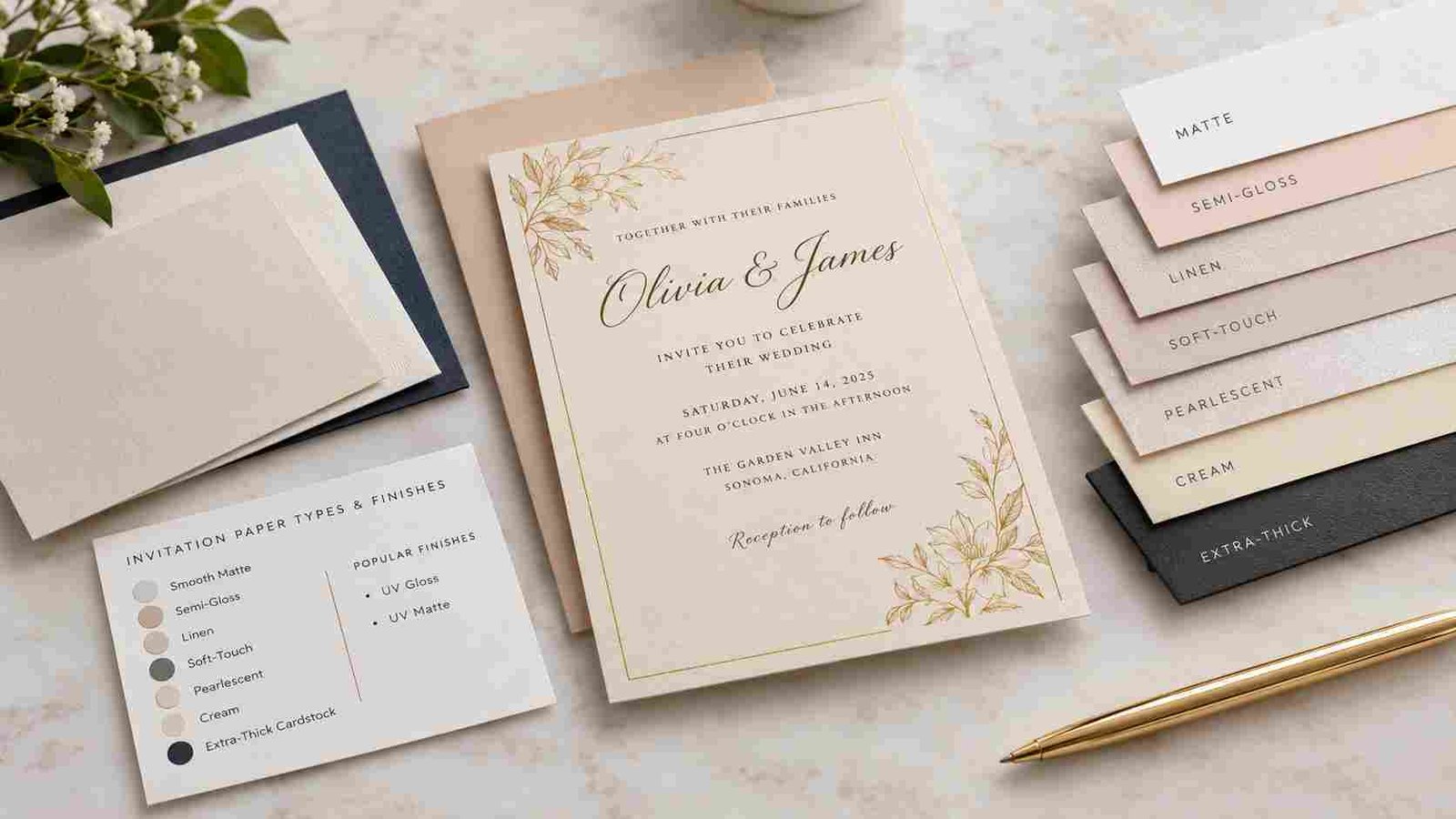
The most common invitation paper types are smooth matte, semi-gloss, linen, soft-touch, pearlescent, cream and extra-thick cardstock, with coatings like UV gloss or UV matte. Adobe Express lets you design and order print invitations on all of these in 5 x 7 or 3.5 x 5 inch sizes, or download a PDF to print elsewhere.
What Paper Stocks and Finishes Are Available for Invitation Printing?
Invitation printing paper stocks differ in three ways: thickness, surface texture and coating. Adobe Express offers nine invitation papers in three tiers, which cover the finishes most hosts look for.
| Tier | Paper | What it does |
| Standard | Signature Matte | Smooth, eggshell texture at an 18 pt weight |
| Standard | Basic Semi-Gloss | Bright color with a subtle shine; the budget pick |
| Premium | Linen | Light woven texture that suits traditional designs |
| Premium | Soft Touch | Smooth, satin feel on both sides |
| Premium | Pearlescent | Soft, light-catching glow |
| Signature | UV Gloss | Protective coating that keeps photos and bold color sharp |
| Signature | UV Matte | Thicker, stiffer stock with a protective coating |
| Signature | Cream | Traditional off-white with a smooth finish |
| Signature | Double-Thick | The heaviest option, for formal events |
Printed orders ship within the US, UK, Australia and Canada, with free shipping and returns, and arrive in 100% recyclable packaging. Outside those countries, you can still design the invitation and download it as a PDF, JPG or PNG for a local printer.
How Do You Pick a Paper Stock and Finish for Custom Invitations?
Start with your design, then match the paper stock and finish to it.
- Photo invitations: UV gloss or semi-gloss keeps colors bold and sharp. Matte cuts glare but softens color slightly.
- Text-led or formal designs: Matte, cream and linen read cleanly, and uncoated matte surfaces are easier to sign or write on than gloss.
- Weddings and milestone events: Double-thick, soft-touch and pearlescent papers add weight and a premium feel.
- Casual parties on a budget: Semi-gloss gives bright color at the lowest tier.
When you compare printers, check the units. Points measure thickness, and 1 pt equals 0.001 inch, so an 18 pt card is about 0.018 inch thick. Pound ratings depend on the paper family: 80 lb text is a thin sheet, while 80 lb cover is sturdy cardstock. Always read the word after the number.
Where Can You Get Custom Invitations Printed on Different Papers?
If you want several paper choices for custom invitations printing, there are three common routes. Each suits a different budget, timeline and level of finish.
| Option | Best for | Key details |
| Adobe Express | Designing and ordering in one place | Nine paper types; 5 x 7, 7 x 5, 3.5 x 5 and 5 x 3.5 inch sizes; ships to the US, UK, Australia and Canada; PDF, JPG or PNG download |
| Minted | Wedding suites with specialty printing | Digital, foil-pressed and letterpress printing; free wedding sample kit |
| Local stationery or letterpress studio | Hand-finished or unusual work | Paper, pricing and turnaround quoted per job |
Adobe Express is the simplest route when you want to start from a template or your own photos, pick a paper and place the order without moving files between tools. A specialty stationer makes sense when a printing method such as foil or letterpress matters more than speed. A local studio is worth a visit if you want to handle paper samples before you commit or need a size the others don’t list.
Cardstock, Foil and Other Custom Invitation Paper Types
Cardstock is the heavy, cover-weight paper most invitations print on. Premium invitations often sit around 350 gsm, which is roughly 130 lb cover or 16 to 18 pt. On Adobe Express, Signature Matte is 18 pt, and Double-Thick is the heaviest choice.
Foil is a printing method, not a paper. Metallic foil is heat-pressed onto the card, so it reflects light in a way ink can’t. Foil stamping isn’t among the invitation papers Adobe Express lists, so if real foil is essential, a specialty stationer is the better fit. For shimmer on a digital print, pearlescent paper adds a soft glow, and gold-toned graphics in your design pair well with it.
Letterpress presses the design into thick paper, often cotton, and leaves a visible impression you can feel. It usually needs a longer lead time and a higher budget, so plan it early.
Frequently Asked Questions
What paper weight is best for invitations?
For a card that feels solid in the hand, choose 16 pt or heavier, or about 350 gsm. Lighter stock around 12 pt works for casual parties. If you’re unsure, order a single copy first and check the feel before printing the full set.
Can I print invitations at home on cardstock?
You can, but most home printers struggle with stock heavier than about 110 lb cover (300 gsm). For heavier papers, download your design as a PDF and take it to a print shop, or order printed copies directly through Adobe Express.
Which file format should I use to print invitations?
PDF is the safest choice because it keeps text and layout fixed. Adobe Express exports PDF, JPG and PNG. For photos or artwork in the design, use images of at least 300 DPI so they print sharply.