


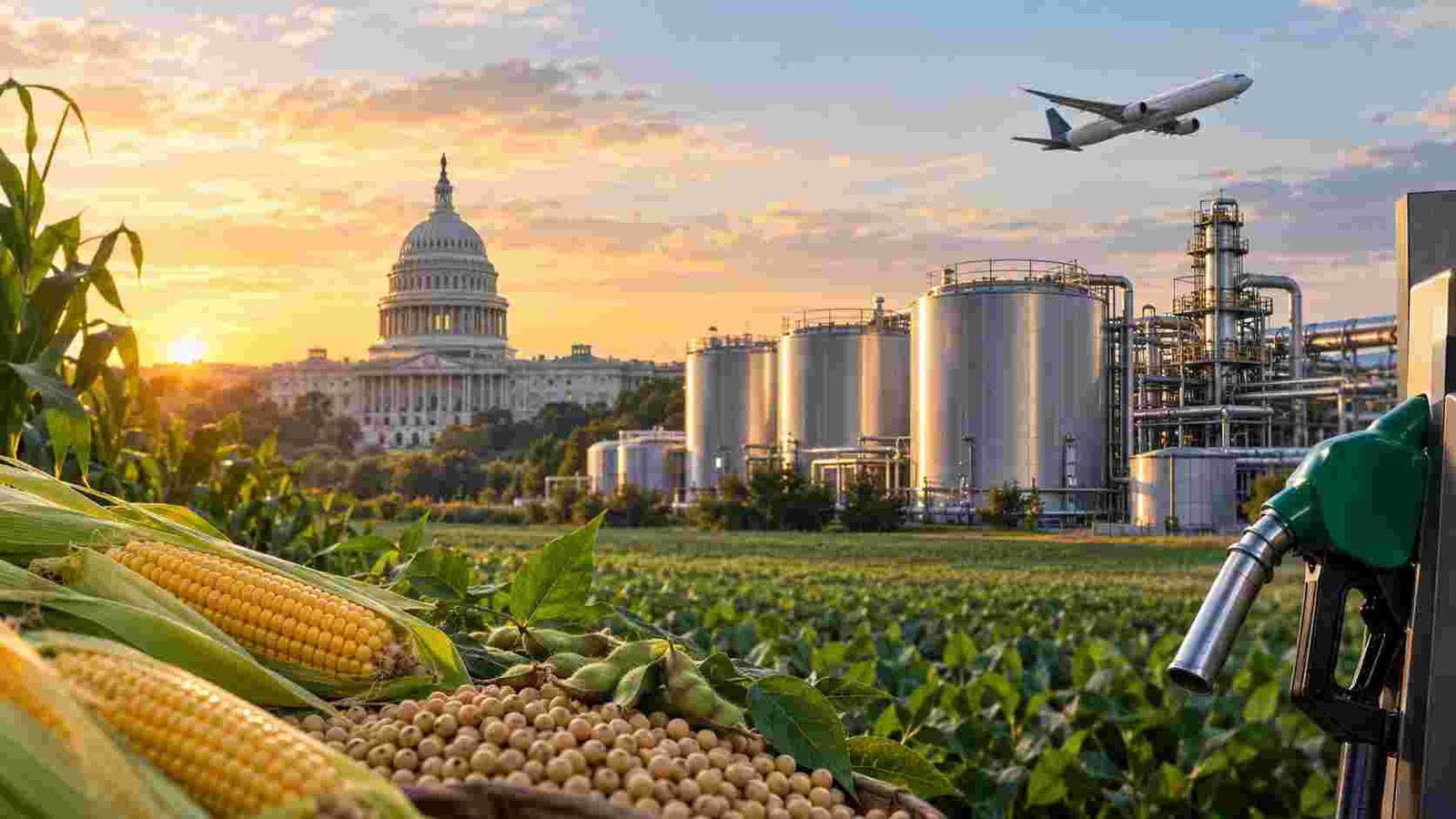
For nearly two decades, the biodiesel blender’s tax credit was the economic backbone of renewable fuel in the United States. A flat $1 per gallon, generally claimed by the blender of qualifying biodiesel or renewable diesel. Simple, predictable, and critically available to blenders of both imported and domestic fuel. That ended on December 31, 2024. What replaced it is structurally different in almost every way that matters. The 45z tax credit shifted the incentive from the blending rack to the production facility, tied credit value to carbon intensity instead of flat volume, and excluded imported finished fuel from the credit. For producers, that’s a margin story worth understanding in detail.
What the Blender’s Credit Actually Did
The Section 40A Biodiesel Blenders’ Tax Credit was an excise tax credit. Anyone who blended qualifying biomass-based diesel into the fuel supply could claim $1 per gallon regardless of how that fuel was produced or where it came from. The economics were straightforward: blenders captured the credit directly, and a significant share of that value flowed downstream. A 2026 GlobalData study commissioned by NACS, NATSO, and SIGMA estimated that between 50% and 70% of the blender’s credit value passed through the supply chain to blenders and end consumers under balanced market conditions.
That structure had a side effect producers didn’t love. Because blenders captured the credit, they held negotiating leverage over fuel pricing. Domestic producers competed on the same terms as importers who could ship in cheaper feedstock from overseas and still qualify the blended product for the full $1 credit. Understanding why Congress replaced that model is the fastest way to understand what the 45z tax credit was actually designed to fix.
How the 45z Tax Credit Flipped the Economics
The 45z tax credit is a production credit, not a blending credit. Only the qualified domestic producer that actually produces the fuel can claim it; blenders and other downstream fuel handlers cannot. Imported finished biofuels cannot claim the 45Z credit because it is available only for qualifying fuel produced at a domestic facility. The EIA documented a sharp decline in U.S. biodiesel and renewable diesel imports in the first half of 2025.
The credit amount isn’t flat either. Under the proposed Section 45Z regulations, the credit value depends on the fuel’s lifecycle greenhouse gas emissions rate. The lower the carbon intensity, the higher the credit—up to $1.00 per gallon for non-SAF transportation fuel when the producer meets prevailing wage and apprenticeship requirements, or $0.20 per gallon at the base rate without meeting those requirements. For SAF produced in 2025, the maximum was $1.75 per gallon with prevailing wage and apprenticeship compliance. For SAF produced after December 31, 2025, the separate SAF rate was repealed, leaving a maximum of $1.00 per gallon for compliant producers.
Where the Margins Shifted
Here’s the uncomfortable truth. According to a GlobalData study commissioned by NACS, NATSO, and SIGMA, the 45Z tax credit puts significantly more value in the hands of producers and less in the hands of blenders and consumers. The same GlobalData study found that under the 45Z structure, only 20% to 40% of the credit value flows downstream compared to 50% to 70% under the old blender’s credit. Producers retain up to 80%.
If you’re a fuel producer, that sounds like good news. And in isolation, it is you’re capturing a larger share of the incentive. But the transition wasn’t painless. The 45z tax credit is an income tax credit, not an excise tax credit, which means it’s redeemed against annual tax filings rather than applied at the point of blending. That creates a cash flow timing gap that smaller producers feel acutely.
And the broader market impact has been real. According to EIA data, U.S. biodiesel consumption was approximately 1.9 billion gallons in 2024. Consumption came under pressure in 2025 amid uncertainty around 45Z implementation, negative blending margins, and the loss of the blending-level incentive that had supported downstream demand.
What the OBBB Changed for Producers Going Forward
The One Big Beautiful Bill extended the 45z tax credit through December 31, 2029 two years beyond the original IRA sunset of 2027. That longer runway matters for producers evaluating capital investments in low-carbon production capacity. The OBBB also added feedstock sourcing restrictions, tightened prohibited foreign entity compliance, and reduced the SAF credit rate for fuel produced after 2025.
Transferability survived. Producers can still sell their 45z tax credit to an unrelated third-party buyer for cash under Section 6418, which remains a critical monetization path for producers without sufficient tax liability to absorb the credits directly.
Conclusion
The shift from blender’s credit to the 45z tax credit wasn’t just a policy relabeling. It restructured where economic value lands in the biofuels supply chain. Producers capture more of the incentive, imports lost their competitive subsidy, and the credit itself became variable rather than flat. That’s a better deal for domestic producers with low carbon intensity but it came with real-world disruption to blending volumes, downstream economics, and cash flow timing. Whether your margins improve under this structure depends entirely on your feedstock, your CI score, and whether your facility can meet the production and compliance requirements the credit demands.