


Most investors who follow the Nasdaq have come across both names at some point. Nasdaq Composite. Nasdaq 100. They sound similar, they move in similar directions, and they both represent the same exchange. So why do they sometimes behave differently, and which one actually matters for your investment decisions?
If you have been using FintechZoom to track Nasdaq performance, you may have noticed that different articles reference different benchmarks depending on the context. That is not an accident. For a broader look at how the Nasdaq works, what drives it, and which stocks sit at its core, our FintechZoom.com Nasdaq analysis covers the full picture. This article focuses specifically on the difference between the two main Nasdaq benchmarks and what that difference means in practical terms.
What Is the Nasdaq Composite?
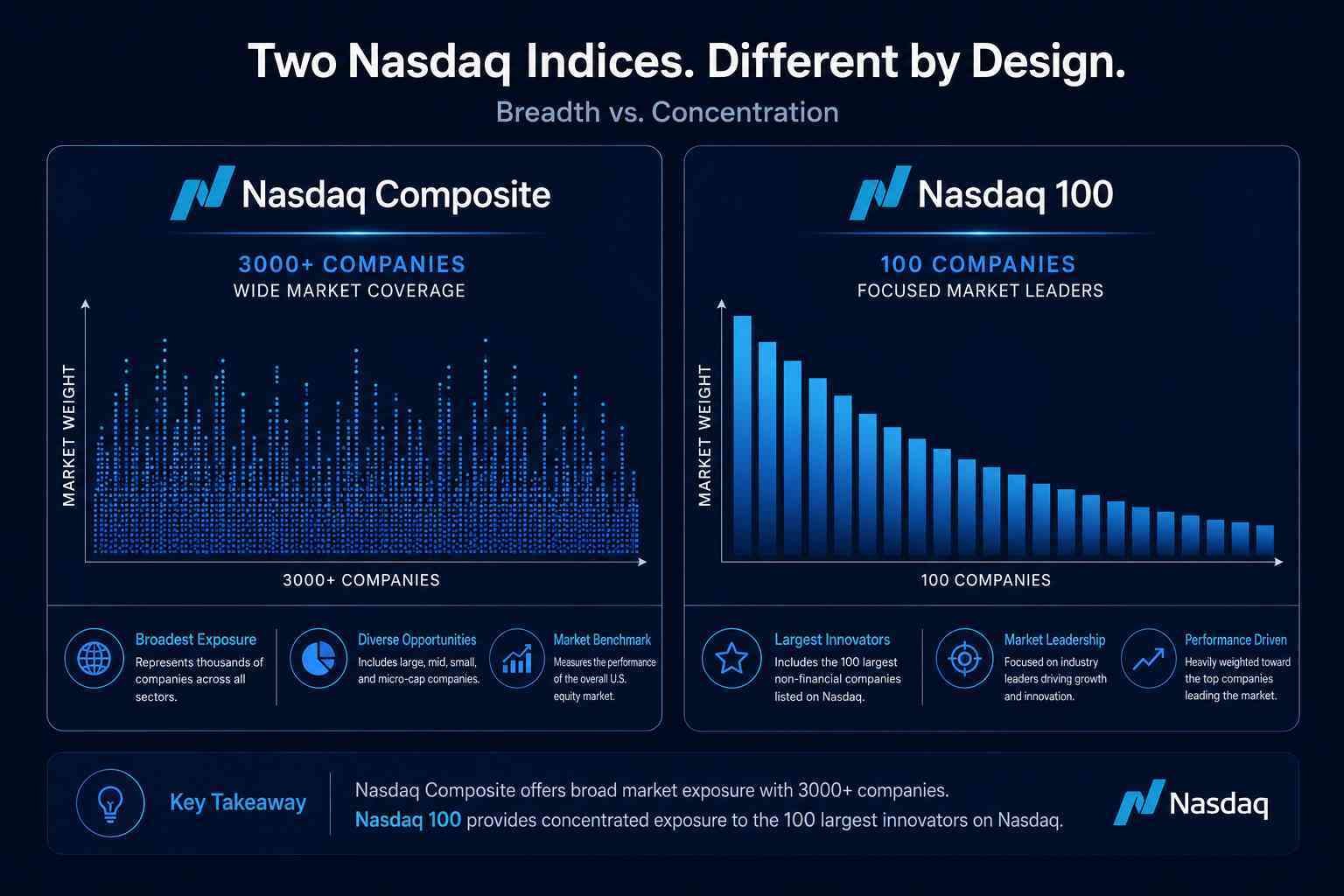
The Nasdaq Composite is the broadest measure of the Nasdaq exchange. It tracks every single company listed on the Nasdaq, which currently means more than 3,000 stocks spanning technology, healthcare, consumer goods, financial services, industrials, and more.
Because it includes so many companies across so many sectors, the Nasdaq Composite gives you a wide-angle view of the exchange as a whole. A single earnings miss from one company barely moves the needle. What shifts the Composite is broad market sentiment, sector-wide moves, and macroeconomic developments that affect large groups of companies simultaneously.
That said, the Composite is still heavily tilted toward technology. The largest companies in it by market capitalization are the same mega-cap tech names that dominate financial news. Their size means they carry more weight in the index than smaller companies, even though those smaller companies are technically included.
For investors who want to understand how the full Nasdaq universe is performing, the Composite is the right benchmark. It captures small-cap and mid-cap companies alongside the giants, which gives a more complete picture of market breadth and overall investor participation.
What Is the Nasdaq 100?
The Nasdaq 100 is a narrower, more focused index. It tracks the 100 largest non-financial companies listed on the Nasdaq, selected primarily based on market capitalization. Financial companies are deliberately excluded, which means banks, insurance firms, and investment companies do not appear in the Nasdaq 100 regardless of their size.
The result is an index that is almost entirely composed of technology and technology-adjacent businesses. Apple, Microsoft, Nvidia, Amazon, Alphabet, Meta, Tesla, Broadcom, and a handful of others make up the bulk of the index’s weight. When these companies perform well, the Nasdaq 100 rises sharply. When they struggle, the index falls hard.
This concentration is both the Nasdaq 100’s greatest strength and its biggest risk. It gives investors direct exposure to the companies leading innovation in artificial intelligence, cloud computing, semiconductors, and digital services. But it also means diversification within the index is limited compared to broader benchmarks.
The Nasdaq 100 is the index behind the QQQ ETF, one of the most heavily traded exchange-traded funds in the world. When investors or media refer to “buying the Nasdaq,” they are almost always talking about the Nasdaq 100 through QQQ or a similar product.
Nasdaq Composite vs Nasdaq 100: Side by Side
| Feature | Nasdaq Composite | Nasdaq 100 |
|---|---|---|
| Companies Tracked | 3,000+ | 100 |
| Includes Financial Stocks | Yes | No |
| Market Cap Focus | All sizes | Large-cap only |
| Technology Weighting | High | Very High |
| Most Common ETF | ONEQ | QQQ |
| Rebalancing | Continuous | Quarterly |
| Volatility | Moderate to High | High |
| Best Used For | Broad market view | Large-cap tech exposure |
How They Actually Perform Differently
On most trading days, the Nasdaq Composite and Nasdaq 100 move in the same direction. They share so many of the same large components that their daily correlation is very high. But the degree of movement and the behavior during specific market conditions is where the differences become meaningful.
During Strong Bull Markets
When technology and growth stocks are leading the market higher, the Nasdaq 100 tends to outperform the Composite. This happens because the Nasdaq 100 is more concentrated in the exact companies driving those gains. The smaller and mid-sized companies included in the Composite but excluded from the Nasdaq 100 often lag during these periods, which pulls the Composite’s overall return slightly lower.
During Corrections and Bear Markets
The Nasdaq 100 also tends to fall harder and faster during corrections. Because it holds fewer companies and those companies are highly valued growth stocks, any shift in market sentiment away from risk assets hits the Nasdaq 100 disproportionately. The 2022 downturn is a clear example. The Nasdaq 100 dropped significantly more than the Composite during that period because the large-cap tech names that dominate it were exactly the type of stocks that got repriced most aggressively when interest rates rose.
When Small Caps Lead
There are periods when smaller companies outperform mega-cap technology stocks. This often happens when economic conditions favor cyclical and value stocks over growth stocks, or when interest rates are rising and investors rotate toward industries less sensitive to rate changes. During these periods, the Nasdaq Composite can hold up better than the Nasdaq 100 because it includes smaller companies that may be benefiting from those same conditions.
Which One Does FintechZoom Track?
FintechZoom’s Nasdaq coverage references both indices depending on the context. When the analysis is about broad market sentiment or the overall health of the Nasdaq exchange, the Composite is the relevant benchmark. When the focus is on major technology stocks, earnings from large-cap companies, or the performance of AI and semiconductor names, the Nasdaq 100 is the appropriate lens.
Most of the individual stock analysis on FintechZoom involves companies that sit inside both indices. Apple, Microsoft, and Nvidia appear in both the Nasdaq Composite and the Nasdaq 100. The difference is that in the Nasdaq 100, their weight and influence are even more pronounced.
Understanding which benchmark is being referenced helps you interpret FintechZoom market commentary more accurately. When an article says the Nasdaq rose or fell by a specific percentage, knowing whether that refers to the Composite or the Nasdaq 100 changes how you should interpret the move.
Which One Should You Track as an Investor?
The answer depends on what you are trying to understand or invest in.
Track the Nasdaq Composite if:
- You want to understand the overall health of the Nasdaq exchange
- You are interested in how small and mid-cap technology companies are performing alongside the giants
- You are analyzing broad market breadth and participation
Track the Nasdaq 100 if:
- You are invested in or considering QQQ or similar large-cap tech ETFs
- You want to follow the performance of major companies like Apple, Nvidia, and Microsoft
- You are monitoring AI, cloud, and semiconductor sector trends
- You want to understand the benchmark that most financial media references when discussing Nasdaq performance
For most retail investors, the Nasdaq 100 is the more immediately useful benchmark because it tracks the companies they are most likely holding or watching. The Composite matters more for understanding the broader ecosystem.
A Note on the Nasdaq 100 Rebalancing
One aspect of the Nasdaq 100 that investors should be aware of is its quarterly rebalancing process. Every quarter, the index reviews its components and adjusts weightings. If any single company’s weight becomes too dominant, the index can conduct a special rebalancing to redistribute weight more evenly among its members.
This happened most notably when the combined weighting of the largest Nasdaq 100 components grew so large that regulators required a rebalancing to prevent excessive concentration. These rebalancing events can create temporary price movements in affected stocks as index funds and ETFs adjust their holdings accordingly.
The Nasdaq Composite does not undergo the same type of structured rebalancing because it includes all listed companies and continuously adjusts as new companies list and existing ones are delisted.
Frequently Asked Questions
Is the Nasdaq 100 the same as the Nasdaq Composite?
No. The Nasdaq Composite tracks all 3,000 plus companies listed on the Nasdaq exchange, while the Nasdaq 100 tracks only the 100 largest non-financial companies. They overlap significantly but are different benchmarks with different behaviors.
Which Nasdaq index is QQQ based on?
QQQ tracks the Nasdaq 100, not the Composite. It is one of the most widely traded ETFs in the world and gives investors direct exposure to the 100 largest non-financial Nasdaq companies.
Why does the Nasdaq 100 sometimes move more than the Composite?
Because the Nasdaq 100 is more concentrated in large-cap technology and growth stocks, it tends to amplify moves in either direction. When tech stocks rally strongly, the Nasdaq 100 rises more than the Composite. When they sell off, it falls harder.
Does the Nasdaq 100 include financial stocks?
No. Financial companies are specifically excluded from the Nasdaq 100. This is one of the key structural differences between the Nasdaq 100 and the Composite, which does include financial sector companies.
Which index should a beginner follow?
For most beginners, the Nasdaq 100 is more practical to follow because it covers the major technology companies that dominate financial news. Once you are comfortable with how large-cap tech stocks behave, expanding to the Composite gives additional context about the broader Nasdaq market.
How often does the Nasdaq 100 rebalance?
The Nasdaq 100 rebalances quarterly. In some cases, a special rebalancing can occur if any single company’s weighting becomes too large relative to the rest of the index.
Conclusion
The Nasdaq Composite and Nasdaq 100 are related but distinct benchmarks. The Composite gives you the full picture of the Nasdaq exchange across thousands of companies. The Nasdaq 100 gives you a sharper, more concentrated view of the largest technology leaders driving the market.
Both matter. Both tell you something different. And knowing which one you are looking at when you read market analysis makes you a more informed investor.
This article is for informational and educational purposes only and does not constitute financial advice.
David Harvey is a Financial Markets Analyst specializing in global markets, investing trends, fintech innovation, cryptocurrency and economic developments. He focuses on delivering data-driven financial analysis and simplified market insights for modern readers and investors.