


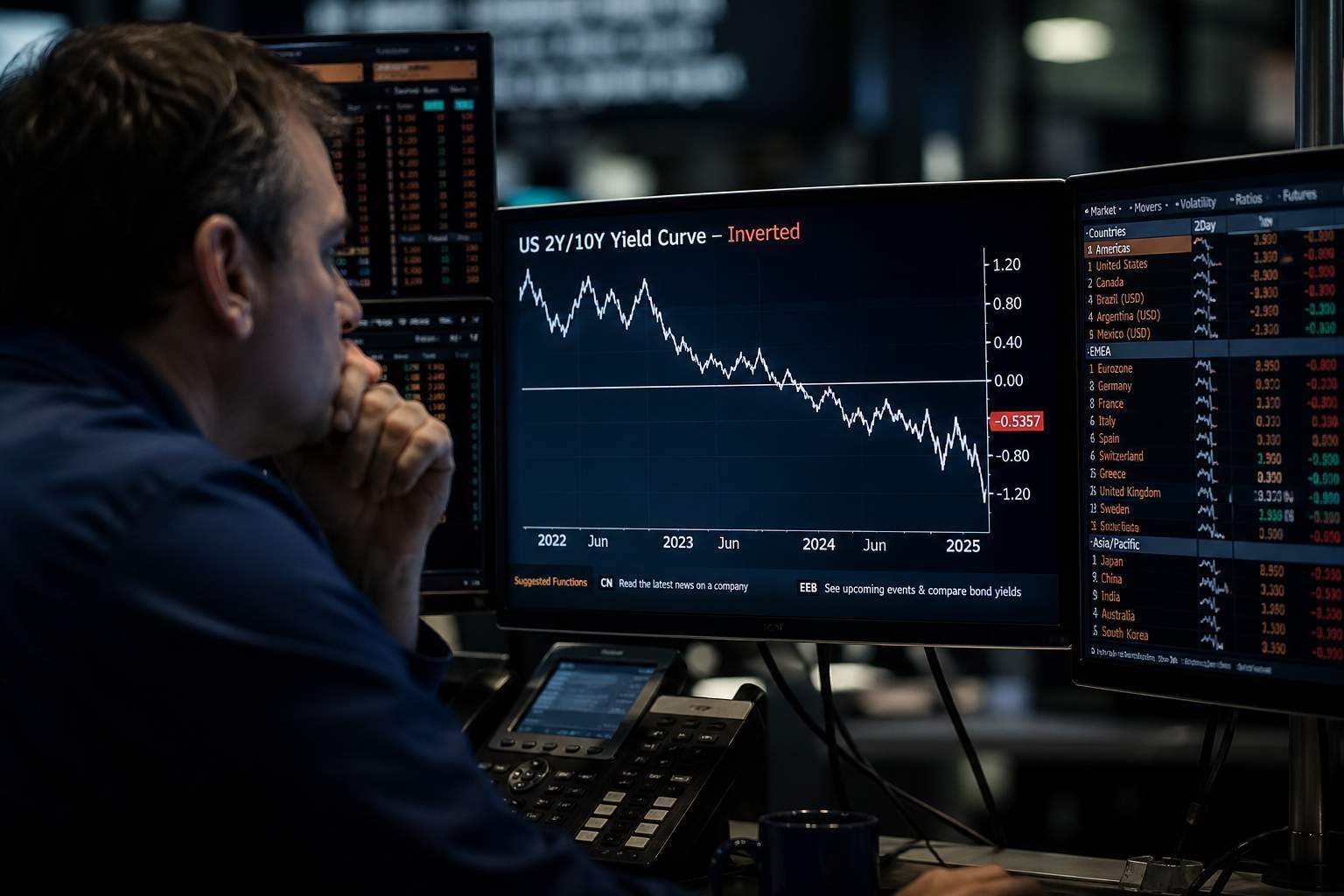
An inverted yield curve is widely viewed as a warning that economic momentum is weakening and that financial conditions may tighten ahead. It reflects a situation where short-term interest rates move above long-term rates, signaling that markets expect slower growth and potentially lower interest rates in the future.
This shift does not happen randomly. It usually develops when central banks raise short-term rates to control inflation while long-term expectations begin to soften. Investors start positioning for a future where current economic strength cannot be sustained, and that change in outlook is quickly reflected in bond yields.
The signal carries weight because it captures both policy pressure and market expectations at the same time. It is not simply about interest rates moving in different directions, but about how investors interpret the balance between present conditions and future risks.
What “Inversion” Actually Means in Practical Terms
Under normal conditions, longer-term bonds offer higher yields than short-term ones. Investors expect to be compensated for time, uncertainty, and inflation risk. That upward slope is what markets consider a healthy baseline.
An inversion flips that structure. Short-term yields move above long-term yields, which signals a shift in expectations rather than a random distortion. It suggests that current conditions, often shaped by tighter policy, are stronger than what investors expect in the future.
This change is not about a single data point. It reflects a broader adjustment in how markets view growth, inflation, and interest rates over time. When the curve inverts, it implies that investors see more risk ahead than stability.
Why Markets React Strongly to Yield Curve Inversion
An inverted yield curve gets attention because it reflects a shift in confidence. When short-term rates rise above long-term yields, it suggests that current monetary conditions are restrictive enough to slow future growth.
Markets do not treat this as a minor signal. Investors begin to reassess risk across assets, especially when the inversion deepens or persists. It often leads to a more cautious stance, with capital moving toward safety and away from growth-sensitive areas.
There is also a signaling effect. An inversion tends to reinforce expectations that central banks may eventually need to reverse course and lower rates. That anticipation feeds back into bond pricing and amplifies the market’s reaction.
What makes this important is not just the inversion itself, but the shift in positioning that follows. Markets begin to prepare for a different economic environment, and that adjustment spreads beyond bonds into equities and credit.
The Link Between Inversion and Economic Slowdown
An inverted yield curve points to a mismatch between current policy conditions and future growth expectations. Short-term rates are usually elevated because central banks are trying to control inflation. At the same time, long-term yields remain lower because investors expect that this tightening will eventually slow the economy.
That gap reflects a shift in outlook. Markets begin to price in weaker demand, softer business activity, and a potential easing cycle down the line. It is less about predicting an exact recession date and more about recognizing that growth is likely to lose momentum.
The signal gains credibility when it persists. A brief inversion can be dismissed as noise, but a sustained one suggests that the underlying economic pressure is building rather than fading.
When an Inverted Yield Curve Does Not Tell the Full Story
An inversion carries weight, but it is not a standalone forecast. Markets can signal stress well in advance of any visible slowdown, which creates a timing gap between the signal and actual economic impact. That gap is where most misinterpretations happen.
There are also periods where structural factors distort the curve. Strong demand for long-term bonds, global capital flows, or central bank balance sheet actions can hold long-term yields lower than expected. In those cases, the curve may invert without reflecting the full strength of underlying economic conditions.
It is also possible for the economy to remain resilient longer than markets anticipate. Growth does not slow immediately after inversion, and in some cases, risk assets continue to perform before conditions tighten meaningfully.
This is why experienced investors avoid treating inversion as a trigger. It is a signal that needs context, not a definitive outcome on its own.
How Bond Markets Price Future Conditions
Bond markets are forward-looking by design. Yields adjust based on where investors believe the economy is heading, not where it stands today. That’s why shifts in expectations often show up in the yield curve before they appear in economic data.
When the curve inverts, it reflects a view that current policy is tight relative to future conditions. Investors begin pricing in slower growth, lower inflation, and eventually, a change in interest rate direction. Those expectations pull long-term yields lower even as short-term rates remain elevated.
This process happens continuously. Markets reassess incoming data, policy signals, and global conditions, and yields adjust accordingly. The curve becomes a reflection of collective expectations rather than a static measure.
Understanding this forward-looking nature is key. Without it, yield curve movements can seem disconnected from reality. In practice, they are often an early indication of how financial conditions are expected to evolve.
Impact Across Financial Markets
An inversion rarely stays contained within the bond market. Once the signal appears, its influence begins to spread across other asset classes, often changing how investors assess risk.
Equity markets tend to feel the shift through valuation pressure and sentiment. When the curve inverts, it suggests that future growth may slow, which can weigh on expectations for corporate earnings. The reaction is not always immediate, but it builds as the signal persists.
Credit markets respond in a more direct way. Lenders become cautious, spreads can widen, and financing conditions gradually tighten. This reflects a broader move toward risk management rather than expansion.
The overall effect is a change in positioning. Investors begin to favor stability over growth, adjusting portfolios to reflect a more uncertain outlook.
How Investors Read Yield Curve Signals
Professional investors rarely treat inversion as a simple on or off signal. What matters is how deep the inversion becomes and how long it holds. A mild, short-lived inversion carries less weight than one that persists across multiple maturities.
Attention often shifts to the spread between key yields, particularly short-term versus long-term government bonds. Changes in that spread give a clearer picture of how expectations are evolving over time.
Timing also plays a role. Markets can remain stable for a while even after inversion begins, which is why experienced investors focus on trends rather than reacting to the initial shift.
The signal becomes more meaningful when it aligns with other indicators such as tightening credit conditions or slowing economic data. In isolation, it is a warning. In combination, it becomes a stronger confirmation.
A Broader Market Perspective
Yield curve movements do not operate in isolation. They are part of a broader system where interest rates, inflation expectations, and investor positioning interact continuously. Looking at the curve alone can highlight shifts in sentiment, but it does not capture the full picture of how bond markets respond to changing conditions.
A more complete understanding comes from observing how these signals align with wider fixed-income trends. This includes how yields move across different maturities, how expectations evolve, and how markets interpret economic risk. A broader view of these dynamics is explored in bond market signals and trends, where yield behavior is examined within the full market context.
Conclusion
An inverted yield curve reflects a shift in expectations from current strength toward future uncertainty. It signals that financial conditions may already be tight enough to slow growth, even if that slowdown has not yet appeared in the data.
The value of the signal lies in how it is interpreted. Rather than reacting to the inversion itself, investors benefit from understanding what it reveals about the direction of the economy and the path of market expectations.
David Harvey is a Financial Markets Analyst specializing in global markets, investing trends, fintech innovation, cryptocurrency and economic developments. He focuses on delivering data-driven financial analysis and simplified market insights for modern readers and investors.